


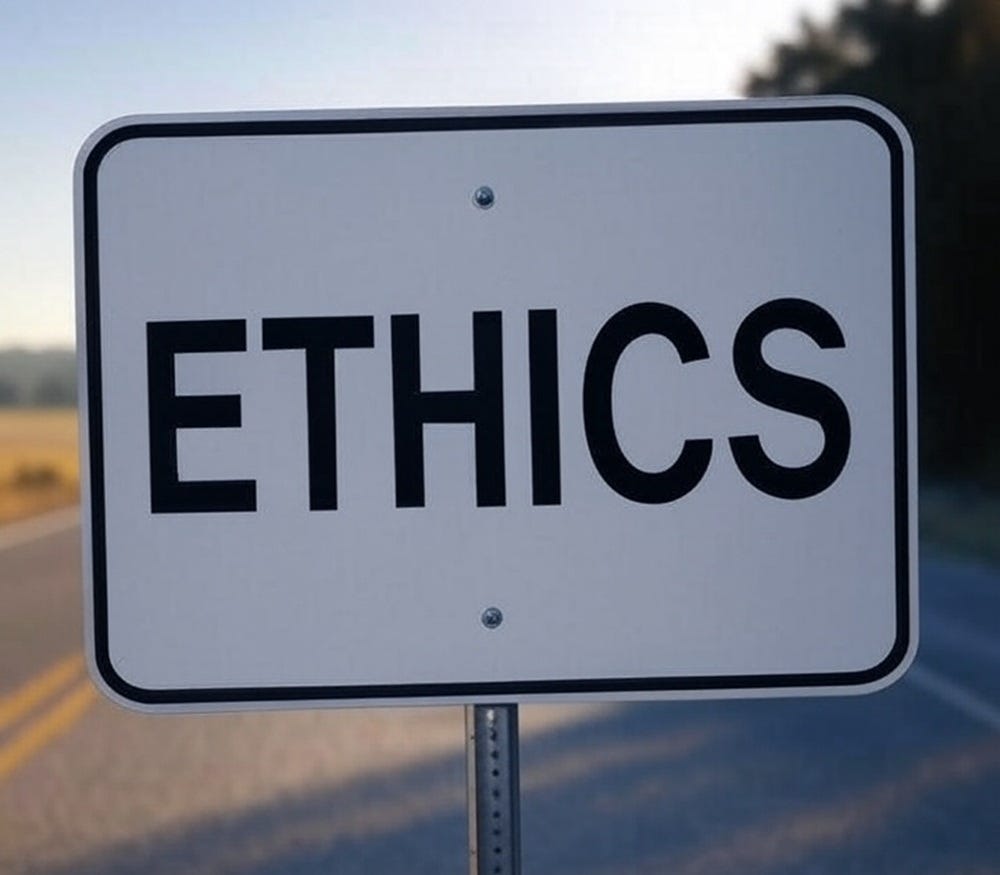
In today’s fast-paced, deal-driven world, the pursuit of profit often overshadows basic human decency. The mantra seems to be: get the best deal, no matter the cost. If a few people are hurt or a few corners are cut on the way to closing, so what? The deal is done, and that’s what counts. But at what price does this relentless focus on winning come? Where have ethics gone, and why does it feel like they’ve been left behind?
Not long ago—perhaps as recently as twenty years ago—business could be conducted on a handshake. Trust was the currency of commerce, and a person’s word was their bond. Today, that trust has eroded. Transactions now require layers of lawyers, airtight contracts, and paper trails so extensive they could decimate entire forests. The shift reflects a broader societal change: a decline in ethical standards that once guided business practices.
I’m reluctant to admit it, but the community I live in has earned a dubious distinction as one of the lowest-ranked areas for ethical behavior. From managers to business owners, buyers to sellers, ethical lapses are rampant. People bend the truth, manipulate deals, or prioritize profit over principle, all in pursuit of a quick buck. The problem has grown so severe that the local university’s Business Department now mandates a Business Ethics course for all its students—a clear sign that the issue can no longer be ignored.
What’s driving this ethical decline? Some point to a culture of greed, where short-term gains trump long-term integrity. Others argue that the complexity of modern business, with its global supply chains and cutthroat competition, creates pressure to compromise. The dictionary defines ethics as “moral principles that govern a person’s or group’s behavior.” Yet, in practice, these principles seem to be forgotten or redefined to suit convenience.
Leadership expert and bestselling author John C. Maxwell offers a striking perspective on this issue. When asked to define business ethics, he famously replied, “There’s no such thing as business ethics.” Maxwell wasn’t dismissing the need for ethics in business; rather, he was emphasizing that ethics should not be compartmentalized into a separate category for commerce. Ethics are universal. The same moral principles that guide personal conduct—honesty, fairness, and respect—should govern business dealings.
As Maxwell elaborates in his book Ethics 101, “If you have integrity, nothing else matters. If you don’t have integrity, nothing else matters.” His point is clear: there’s no room for a double standard where personal ethics differ from professional ones.
The erosion of ethics has tangible consequences. Trust between businesses and consumers frays, leading to skepticism and disengagement. Employees become cynical, disempowered by workplaces that reward unethical behavior. In my community, for instance, stories abound of contractors inflating invoices, retailers misrepresenting products, or employers exploiting workers to cut costs. These actions don’t just harm individuals—they undermine the social fabric that businesses rely on to thrive.
Nobel Peace Prize winner Albert Schweitzer argues that ethical behavior is not just a moral imperative but a practical one. "Ethics, too, are nothing but reverence for life. That is what gives me the fundamental principle of morality, namely, that good consists in maintaining, promoting, and enhancing life, and that destroying, injuring, and limiting life are evil,” he is quoted as saying. Applied to business, this suggests that ethical conduct doesn’t require superhuman virtue—just a commitment to doing what’s right, even when it’s inconvenient or less profitable.
So, what’s the solution? Politicians often advocate for more regulation, believing that stricter laws will curb unethical behavior. Consumers, on the other hand, demand lower prices, hoping affordability will level the playing field. Business leaders, meanwhile, often resort to more paperwork—compliance forms, audits, and certifications—as a way to signal accountability. But these approaches miss the mark.
Regulations can be circumvented, lower prices don’t address underlying moral failures, and paperwork often becomes a bureaucratic shield rather than a genuine commitment to change.
The real issue lies in a collective amnesia about what ethics truly mean. Ethics aren’t just rules to follow; they’re a mindset, a set of values that shape how we treat others. As Maxwell suggests, the solution starts with embracing a single standard of integrity that applies across all aspects of life. Whether rooted in religious beliefs, a personal creed, or a commitment to fairness, these principles should guide every decision, from how we negotiate deals to how we treat employees and customers.
Rebuilding an ethical business culture requires action at multiple levels. First, individuals must hold themselves accountable. This means refusing to compromise on honesty, even when it’s tempting to bend the truth for a competitive edge. As Warren Buffett, one of the world’s most respected business leaders, once said, “In looking for people to hire, you look for three qualities: integrity, intelligence, and energy. And if you don’t have the first, the other two will kill you.” Integrity isn’t just a nice-to-have—it’s the foundation of sustainable success.
Second, businesses must foster environments where ethical behavior is rewarded, not punished. This could mean implementing transparent policies, providing ethics training, or creating mechanisms for employees and customers to report unethical practices without fear of retaliation. Universities, like the one in my community, play a vital role by equipping future leaders with the tools to navigate ethical dilemmas. But education alone isn’t enough; it must be paired with real-world accountability.
Finally, consumers have a role to play. By supporting businesses that prioritize ethics—whether through fair labor practices, sustainable sourcing, or honest marketing—consumers can drive demand for principled commerce. As the late economist Milton Friedman noted, “The social responsibility of business is to increase its profits.” But he also acknowledged that businesses operate within the “rules of the game,” which include society’s ethical expectations. When consumers demand integrity, businesses are forced to adapt.
The decline of ethics in business isn’t inevitable. It’s the result of choices—choices to prioritize profit over people, expediency over fairness. But just as individuals and businesses have chosen this path, they can choose a different one. Let’s commit to treating each other with respect, holding ourselves and others accountable, and rebuilding a culture where a handshake still means something.
Ethics aren’t a relic of the past; they’re the key to a future where business thrives not at the expense of others, but because of the trust and integrity we bring to every interaction.
What do you think? Let me know in the comments below. Tell me if there is an anime, comic book, movie, or novel you would like me to review.